23 Small Kitchen Ideas That Make a Tight Space Actually Work
Small kitchens have a way of making you feel like you are fighting the room every single time you cook. There is never enough counter space, the cabinets are always full, and the moment you open two cabinet doors at once, the whole thing feels like a game of Tetris you cannot win. But a small kitchen is not a bad kitchen. It is just a kitchen that needs a smarter setup. The ideas in this list are not about gutting the room or spending a lot of money. They are practical, realistic changes that work in real homes with real budgets. Some of them are free. A few cost under twenty dollars. All of them make a genuine difference in how much a small kitchen can actually do.
1. Open Shelving Instead
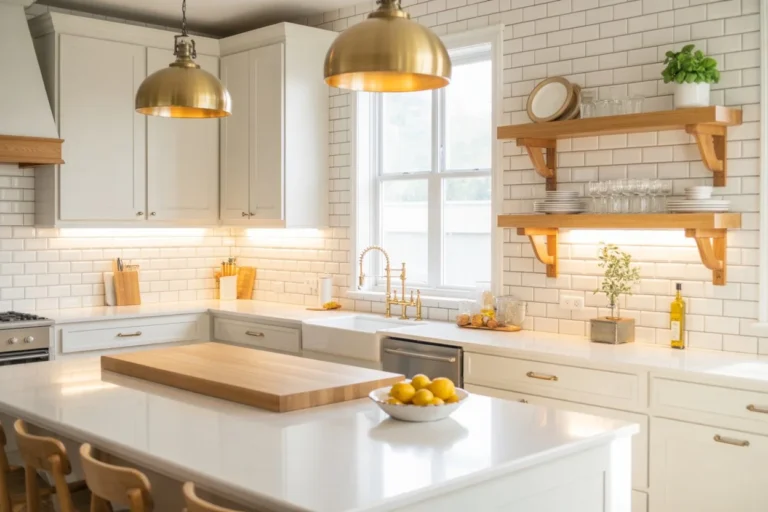
Replacing upper cabinet doors with open shelving, or removing one set of upper cabinets entirely, is one of the most effective ways to open up a small kitchen visually. Closed cabinet faces read as a solid wall of storage, which makes the kitchen feel boxed in even when there is decent square footage. Open shelves let the eye move through the space, which creates a sense of depth that closed cabinets simply cannot provide. Style the shelves with a combination of everyday items like stacked plates and glasses alongside a few simple decor pieces like a small plant, a wooden cutting board leaning upright, or a ceramic crock of utensils. The key is to keep the shelves edited and organized rather than stuffed. A well-styled open shelf looks intentional and airy. An overstuffed one looks messier than the cabinet it replaced.
2. Magnetic Knife Strip
A magnetic knife strip mounted on the wall beside the stove frees up an entire drawer or a sizable chunk of counter space in one simple installation. Knife blocks are bulky and take up valuable counter real estate in a small kitchen. A strip keeps knives visible, accessible, and safely stored with the blades away from hands. Most strips are mounted with just two screws and can go up in under fifteen minutes. Look for one that is long enough to hold your full set with a little room between each knife so nothing gets scratched. Stainless steel strips look clean and minimal in most kitchen styles. Wooden strips have a warmer, more organic look that works better in farmhouse or natural-material kitchens. Either way, the counter space you get back is immediate and significant.
3. Over-Door Organizers
The inside of cabinet doors is one of the most overlooked storage spots in a small kitchen. An over-door organizer, the kind that hooks over the top of the door without any screws, can hold spice jars, cleaning supplies, foil and plastic wrap rolls, pot lids, or small pantry items depending on where it is placed. Under the sink cabinet doors are especially useful for this since that space tends to be awkward and underused. Pantry cabinet doors can hold a full spice rack or a row of small bins for packets and seasoning mixes. Most over-door organizers require no tools and cost between ten and twenty-five dollars. They are also fully removable, which makes them a good option for renters or anyone who is not sure how long they will be in a space.
4. Pegboard Kitchen Wall
A pegboard mounted on a kitchen wall gives you flexible, adjustable storage for pots, pans, utensils, and small accessories without using a single inch of counter or cabinet space. The beauty of pegboard is that the layout is completely customizable with hooks, small shelves, bins, and holders that can be repositioned anytime without making new holes in the wall. Paint the pegboard the same color as the wall behind it for a more integrated look, or paint it a contrasting color to turn it into a deliberate design feature. Pegboard panels are available at any hardware store and are generally quite inexpensive. The hooks and accessories are sold separately and are also very affordable. In a small kitchen where every cabinet is at capacity, a pegboard wall can absorb a significant amount of the everyday clutter that tends to accumulate on counters.
5. Slim Rolling Cart
A slim rolling kitchen cart that fits into a narrow gap beside the refrigerator, between cabinets, or at the end of a counter run can add surprising amounts of storage and counter surface to a small kitchen. These carts typically have two or three shelves and a flat top surface that works as an extra prep area when you need it. The wheels make it easy to pull out during cooking and push back out of the way when you are done. Look for carts with a butcher block or bamboo top surface for the most useful prep area. Metal wire shelving underneath is easy to clean and lets you see what is stored on each level. Some carts also come with side hooks for hanging towels, a paper towel holder, or small baskets. A good cart in a narrow size can often be found for well under sixty dollars.
6. Light Paint Colors
In a small kitchen with limited natural light, the wall color has a significant effect on how open and functional the space feels. Dark or heavily saturated wall colors can make a small kitchen feel like a cave, especially if the cabinetry is also a medium or dark tone. Painting the walls in a soft, light color like warm white, pale cream, very light sage, or barely-there gray makes the room reflect more light and feel noticeably more spacious. If you are repainting, extend the color onto the ceiling as well. When the ceiling and walls are the same light tone, the room feels taller and more open. Even if you are renting and cannot paint, keeping the largest visible surfaces like countertops and shelves clean and uncluttered achieves a similar visual effect by keeping the eye moving freely through the space.
7. Wall-Mounted Spice Rack
Spice storage takes up a lot of cabinet space in most kitchens, and in a small kitchen that is shelf space you can barely afford to spare. A wall-mounted spice rack installed on an empty wall section near the stove keeps spices visible and within reach while giving back the cabinet shelf entirely. There are a few good options here. A simple rail system with small jars and magnetic lids is minimal and very easy to read at a glance. A small wooden wall shelf with one or two tiers is a bit more substantial and can hold larger jars and containers. Built-in recessed spice cabinets that sit flush with the wall are the most seamless solution but require a more involved installation. Even the simplest mounted option makes a real difference in how much usable cabinet space you have for other things.
8. Hanging Pot Rack
A ceiling-mounted or wall-mounted pot rack removes the most space-consuming items in most kitchen cabinets, the pots and pans, and relocates them to overhead space that would otherwise go unused. This is one of those changes that immediately makes a small kitchen feel more like a real cook’s kitchen rather than a storage problem. Ceiling-mounted racks work best when there is enough ceiling clearance so that tall people do not bump into them, typically at least seven feet from the floor to the bottom of the rack. Wall-mounted racks work well in kitchens with a stretch of empty wall beside or above the stove. Look for a rack with a mix of hooks at different lengths so different sizes of pots can hang without crowding each other. Most of your lower cabinet space opens up almost completely once the pots and pans move to the rack.
9. Mirrored Backsplash Tiles
A mirrored or highly reflective backsplash does for a small kitchen what a large mirror does for a small bedroom. It doubles the perceived depth of the space by reflecting everything across from it. This is particularly effective in a galley kitchen or a kitchen with one solid wall of cabinetry, where the backsplash can reflect the opposite side and make the room feel like it extends further than it does. Mirrored subway tiles are widely available and install the same way as standard ceramic tiles. If you are renting or want a more temporary solution, peel-and-stick mirrored tile panels are available and look reasonably convincing when installed carefully. Glass or high-gloss tiles in a light neutral color also reflect enough light to brighten and expand the visual space without the full mirror effect.
10. Corner Shelf Units
Corner spaces in a small kitchen are often dead zones. The cabinets are awkward to reach into, the lazy Susan spins things out of reach, and the deep corners swallow small items that never come back out. Adding a simple corner shelf unit, either freestanding or wall-mounted, turns that wasted corner into genuinely useful storage. A tiered corner shelf can hold a stand mixer, small appliances, or a collection of cookbooks. Corner shelves installed in the upper cabinet area can hold dishes, mugs, or decorative pieces that you want visible but not necessarily at arm’s reach. Open corner shelves in particular add to the airy, open quality of a small kitchen because they break up what would otherwise be a solid wall of closed cabinet faces. They are also significantly less expensive than replacing corner cabinets with pull-out systems.
11. Under-Counter Baskets
Baskets or bins slid under an open lower shelf or a kitchen bench add informal storage in small kitchens that have any exposed lower space. This works especially well in kitchens with a freestanding prep table, a kitchen island on legs, or open lower shelving rather than full base cabinets. A row of matching wicker or wire baskets underneath a butcher block prep table can hold fruit, vegetables, dish towels, or cleaning supplies in an organized and visually appealing way. The baskets contain the items while still leaving the floor space open to the eye, which keeps the kitchen feeling less cluttered than closed cabinets at the same height. Label the baskets or use clear bins so you can find things quickly without pulling everything out.
12. Fold-Down Counter Leaf
If your kitchen counter space is genuinely too limited for comfortable food prep, adding a fold-down counter extension that mounts to the wall or to the side of a cabinet can effectively double your work surface when you need it, with nothing jutting out when you do not. These fold-down surfaces, sometimes called Murphy tables or drop-leaf brackets, are wall-mounted and fold flat against the wall when not in use. A folded-down surface can add anywhere from ten to eighteen inches of extra counter depth, which is often enough to give you a full cutting board workspace. Install one near the stove or the sink where you need prep space most. The bracket hardware is inexpensive and most versions can hold a solid wood or plywood top surface that you finish to match your existing counters.
13. Declutter Countertops
This one costs nothing and often makes the single biggest difference in how a small kitchen feels and functions. Counters in small kitchens tend to accumulate appliances, mail, dishes, and miscellaneous items until there is barely room to set down a cutting board. Clearing everything off the counter and then putting back only the things you use every single day can be a genuinely surprising exercise. Most people find that the toaster, the coffee maker, and a wooden utensil crock are the only things that truly earn permanent counter space. Everything else can live in a cabinet and come out when needed. A clear counter also makes the kitchen much easier to clean, which means you actually clean it more often, which keeps the kitchen feeling more functional day to day. Start by putting everything in a box, then only return what you reach for in the next week.
14. Stackable Container System
A matching set of stackable food storage containers used in the pantry or on open shelves makes an enormous difference in how efficiently a small kitchen uses its storage space. Mismatched containers with non-matching lids are inefficient because they cannot be stacked properly, which means they spread out and eat up far more shelf space than their contents require. Matching containers with flat lids stack cleanly and can be organized by size, which lets you use vertical shelf space much more effectively. Decant dry goods like pasta, rice, flour, cereal, coffee, and nuts into labeled containers and you will find that the same amount of food takes up noticeably less space and is much easier to find at a glance. Square containers are especially efficient because they fit together without gaps the way round containers cannot.
15. Small Kitchen Island
In a kitchen that has just enough floor space for it, a slim kitchen island on wheels adds counter space, storage, and a surface for eating or food prep that completely changes how the kitchen functions. The key is choosing an island that is proportional to the room. A too-large island in a small kitchen creates a bottleneck that makes everything harder. A slim island that leaves at least thirty-six inches of clearance on each walkable side gives you extra surface without blocking the flow of the room. Look for an island with a butcher block or solid wood top, a lower shelf for storage, and locking casters so it stays in place during use but can be rolled out of the way for mopping or when you need the floor space. Some slim islands fold down on the sides to be even more compact when not in use.
16. Use Vertical Dividers
Vertical dividers installed inside a base cabinet or a deep drawer let you store baking sheets, cutting boards, pot lids, and sheet pans vertically like books on a shelf instead of stacking them flat. Stacked flat items are almost impossible to access without moving everything on top, which wastes time and causes frustration. Standing them vertically means you can pull out exactly what you need without disturbing anything else. Adjustable vertical dividers are available as cabinet inserts from most kitchen storage retailers and install without tools in most standard base cabinets. This is particularly useful in a small kitchen where base cabinet space is limited and you cannot afford to have even one cabinet that functions poorly. A single well-organized divider cabinet can hold more than double the items of the same cabinet stacked flat.
17. Window Shelf Addition
If your kitchen has a window above the sink or on an adjacent wall, installing a simple narrow shelf just inside or just below the window frame gives you a spot for small plants, herb pots, a few jars of dry goods, or small decorative items without using any counter or cabinet space. The natural light from the window makes this shelf a natural home for a small herb garden with pots of basil, thyme, and rosemary that are useful for cooking and visually pleasing at the same time. Keep the shelf narrow, no more than four to six inches deep, so it does not block too much light from the window. A simple wood shelf painted to match the trim or the wall color looks clean and intentional rather than improvised. This kind of small addition has an outsized effect on how the kitchen feels.
18. Light Under Cabinets
Under-cabinet lighting is one of those small changes that dramatically improves how a kitchen feels and functions. In a small kitchen where the counters are already tight, having good light directly on the work surface makes prep work easier and safer. It also adds a warm, layered quality to the kitchen that makes it feel more intentional and finished. Plug-in LED strip lights or puck lights that mount under the upper cabinets are the easiest option and require no electrical work. Look for warm white LEDs in the 2700K to 3000K range for the most flattering and kitchen-appropriate light. Cool daylight LEDs can make a small kitchen feel sterile rather than welcoming. Stick-on LED strips are widely available for under twenty dollars and can be installed in under an hour. Some come with a remote or a simple touch switch on the strip itself.
19. Toe-Kick Drawers
The space between the bottom of your base cabinets and the floor, called the toe kick, is usually just empty dead space hidden behind a flat panel. In a small kitchen, this overlooked area can be converted into shallow drawers that hold flat items like baking sheets, tablecloths, pizza stones, or serving platters. Toe-kick drawer kits are available from specialty kitchen storage companies and some cabinet manufacturers. The drawers are shallow, usually only three to four inches tall, but they are surprisingly wide since they span the full width of a cabinet run. This is extra storage that takes up zero visual space in the kitchen since the drawers are at floor level and blend into the base of the cabinets. In a small kitchen where every inch of storage counts, this kind of hidden space is genuinely valuable.
20. Narrow Floating Shelves
A narrow floating shelf installed above the backsplash on the wall between the counter and the upper cabinets, or in any gap of empty wall space, adds another horizontal storage surface without intruding on the work area below. This shelf is ideal for small, frequently used items like a salt box, an oil bottle, a small jar of cooking spices, a kitchen timer, or a single small plant. Keep it very shallow, four inches or less, so it does not interfere with the counter space below and so items stored on it stay reachable without stretching. A thin shelf at this height also acts as a subtle decor element that breaks up the expanse of tile or wall between the counter and the upper cabinets. Paint it the same color as the wall for a barely-there look or use natural wood for warmth.
21. Two-Toned Cabinets
In a small kitchen where all the cabinetry is the same color and finish, painting the lower cabinets a different tone from the uppers creates a visual break that makes the kitchen feel less like one solid block of storage. This is a trick that interior designers use regularly in kitchens that feel heavy or visually monotonous. A common approach is to keep the upper cabinets white or a very light color to keep the eye moving upward toward the ceiling, while painting the lower cabinets a warmer or slightly deeper tone like sage green, warm navy, soft charcoal, or dusty terracotta. The contrast draws the eye down to the lower cabinets and creates a furniture-like quality that makes the kitchen look more designed. This is achievable with standard cabinet paint and a good primer for well under a hundred dollars in materials.
22. Bar Cart as Island
A slim bar cart used in place of a traditional kitchen island gives you a movable surface and storage option that works surprisingly well in a tight kitchen. Bar carts typically have one or two shelves, a flat top surface, and wheels, which means you can roll them to where the work is happening and move them out of the way when the kitchen needs more floor space. Style the top with a small cutting board and a utensil holder to make it function as a proper prep station. Use the lower shelves for frequently used items like oils, vinegars, a fruit bowl, or a set of dish towels. A bar cart in a warm wood tone or with a black metal frame looks intentional and stylish rather than like a temporary solution. This is especially useful in kitchens that cannot accommodate a fixed island due to limited walkway clearance.
23. Consistent Storage Labels
One of the quietest things that makes a small kitchen feel chaotic is not being able to find anything quickly. When you have to open three cabinets and dig through mismatched containers before you find what you need, the kitchen feels disorganized regardless of how small or large it is. Labeling everything consistently, from the pantry bins to the spice jars to the cabinet shelves, creates a system that lets anyone find what they need at a glance. Labels do not have to be elaborate. A simple label maker produces clean, uniform text that looks tidy and reads instantly. Chalkboard labels with handwritten text look warmer and more personal. The system matters more than the aesthetic. When everything has a designated spot and that spot is clearly marked, the kitchen runs more smoothly and feels more controlled even when it is being used actively.
A small kitchen does not need more square footage to work well. It needs a better system. Pick the ideas that match the biggest pain points in your current setup and start there. You will likely find that solving two or three core problems makes the whole kitchen feel different.